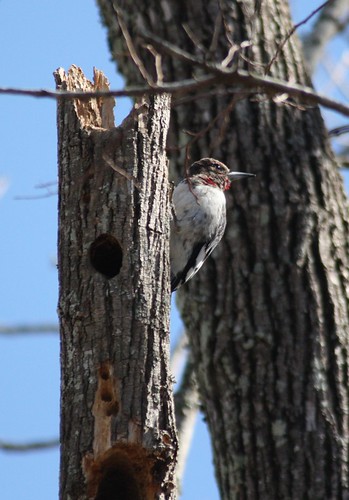
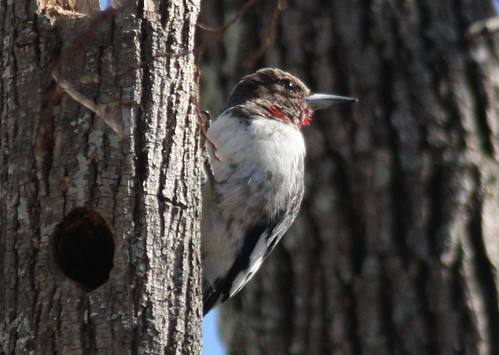
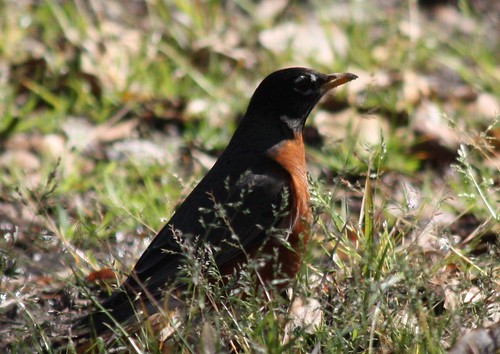
Showing posts with label woodpeckers. Show all posts

Friday, July 22, 2011

Red-headed Crossbill?

... Or "Wicked-billed Woodpecker" — I just couldn't decide.

First let me just say, July in Houston is just plain hot. And muggy. And while I used to do "hot" without any problem, I've become spoiled in my dotage. I like air conditioning much more than I like sweating. So I really haven't done much in the way of birding in a while.

But one day last week, I dropped by the neighborhood park where I often spend my autumn, winter and spring lunch breaks — just to see if the usual Texas-summering birds had come to their senses and left for cooler climes. I expected to find the place pretty quiet right in the heat of the day but boy, was I wrong.

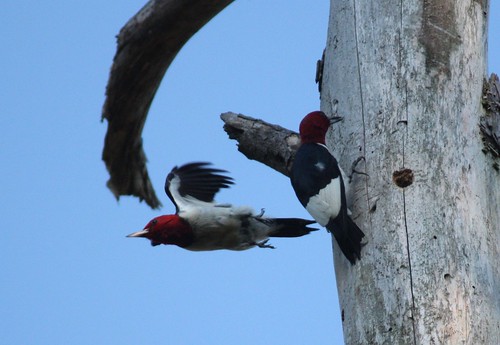
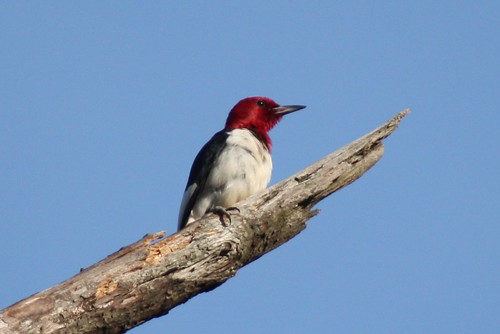
As I pulled up in the parking lot, I immediately spotted the brilliant scarlet streak of a Red-headed Woodpecker flitting between the trees in front of me. I watched from the driver's seat as it zipped back and forth, busily catching grubs and insects to feed a youngster who was following it around, apparently "learning the ropes" (trying to copy the parent but not having any luck catching food on its own). This industrious fellow was presenting a veritable feast for his young fledgling, who gulped down every morsel that was offered.

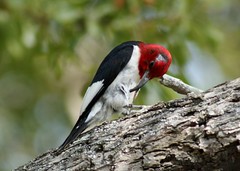
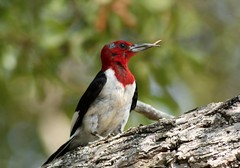
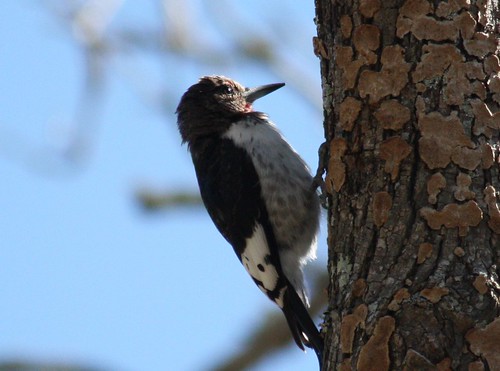
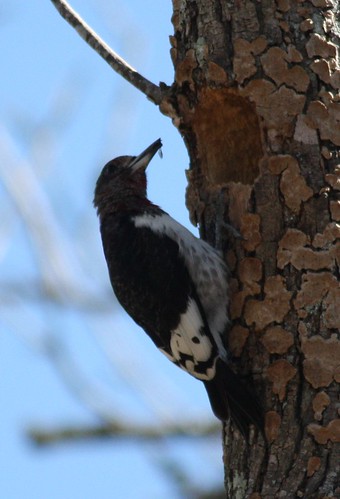
But when I pulled out my binoculars and took a closer look, I discovered something even more interesting than the action itself. The adult woodpecker was "handicapped" with a deformed bill which appeared to be at least twice the size of a normal RHWO bill, thinner than normal and curved to the extent that it must cross the tips in order to close its bill.
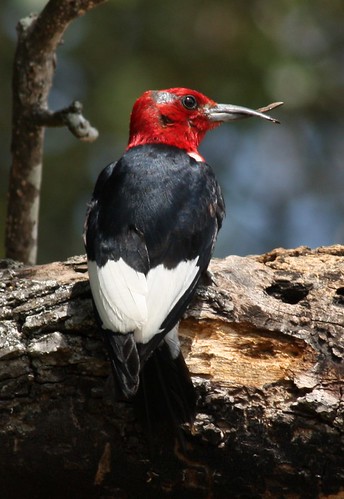
Red-headed Woodpecker, deformed bill
Red-headed Woodpecker (Melanerpes erythrocephalus)


I was amazed at how adept the adult woodpecker was at catching food even with its "handicap." It definitely appears to have adapted to the deformity quite well.

Unfortunately, I didn't have my camera in the car that day; when I returned a couple of days later and got these shots, the juvenile was nowhere to be seen and the adult was just hanging out, taking a break from its hunting. However, I have been back once more since and once again spotted this distinct adult, so I assume it is at least a temporary resident of the area.

Here are a few more shots I snapped of this unique bird. Click on any of the thumbnails to see the full-sized image.
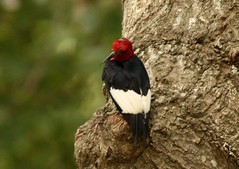
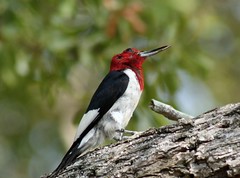
Red-headed Woodpecker, deformed bill     Red-headed Woodpecker, deformed bill

Red-headed Woodpecker, deformed bill     Red-headed Woodpecker, deformed bill


I hope to get back over there early next week to see if the woodpecker is still around, and hopefully to spot and get some pictures of the juvenile as well.

Monday, January 31, 2011

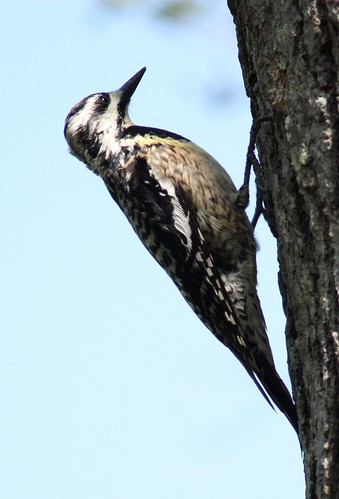
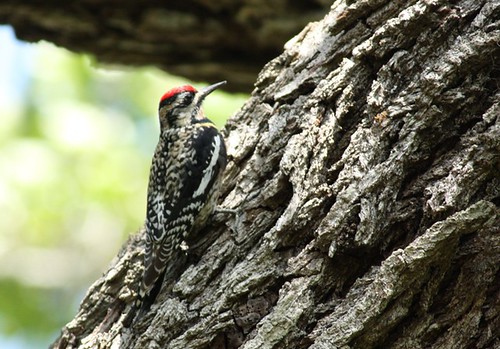
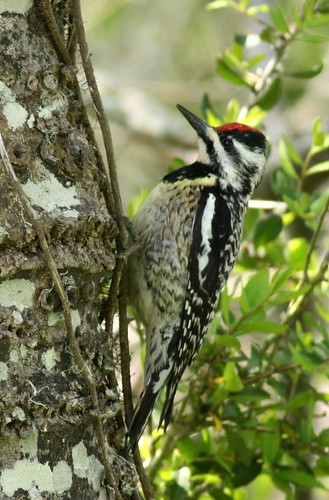
The Daily Bird: Yellow-bellied Sapsucker

Yellow-bellied Sapsucker - 4/16/2010
Yellow-bellied Sapsucker (Sphyrapicus varius)

Yellow-bellied Sapsucker - 4/16/2010

Yellow-bellied Sapsucker - 4/16/2010

Tuesday, November 9, 2010

Back to the Birds

There's nothing like an awesome, spontaneous event to make you realize how much you miss a loved hobby. And quite by accident, that's just what made me realize last week how much I have been missing birding over the past several months.

A week ago Friday, I realized that my son's Cub Scouts camping trip was almost upon us and I had not yet started breaking in my new hiking boots. (When the third set of soles wore out on my old ones, I decided it was finally time to break down and get a new pair.) So I took them to work with the intention of going walking at lunchtime. I happened to still have my camera in the car after Cowboy's last soccer match, so when I got over to Bear Creek park at noon I grabbed the camera just out of habit.

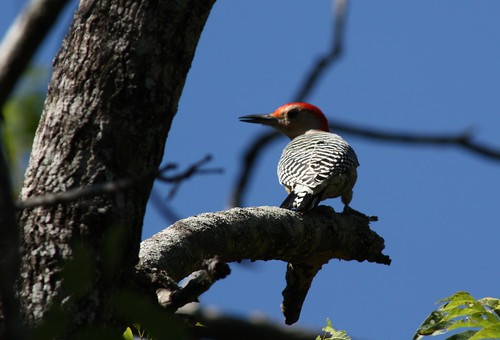
Other than a handful of crows and a Red-tailed Hawk soaring high overhead, I hadn't seen anything of interest by the time I reached my halfway mark and began walking back toward the gravel parking area. Then I heard a familiar call overhead and stopped in my tracks. It took only moments to find them — a pair of Red-bellied Woodpeckers flitting from one tree to the next.

Red-bellied Woodpecker  - 10/29/2010
Red-bellied Woodpecker (Melanerpes carolinus)

Red-bellied Woodpecker - 10/29/2010

I followed the pair for a few minutes, trying to get a good shot or two, but was quickly distracted by a soft hammering just a bit further down the trail. Following the sound, I came across another, smaller woodpecker — this little downy female, drumming away on a small branch above me:

Downy Woodpecker - 10/29/2010
Downy Woodpecker (Picoides pubescens)

Very shortly after this sweet find, yet another distraction flew right by the downy's tree. The third member of the woodpecker family within five minutes.

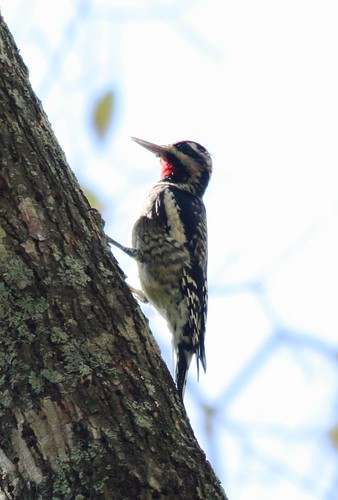
Yellow-bellied Sapsucker - 10/29/2010
Yellow-bellied Sapsucker (Sphyrapicus varius)

What a day this was turning out to be! I was smiling broadly over my good fortune as I turned back down the trail in the direction of my truck. Three woodpecker species in one quick, unplanned outing, and it was the first time I'd been birding since spring migration. You just can't beat that.

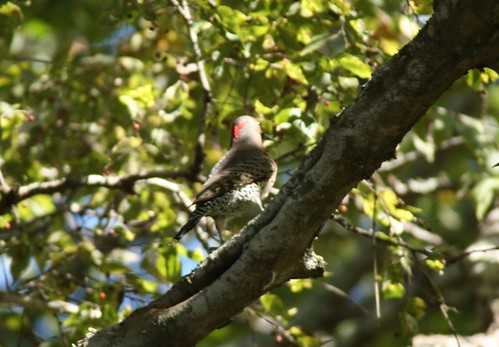
Until those red-bellied fellows flew back into view, this time accompanied by what I first thought was a female of the breed. She was pretty elusive, but it had to be another red-bellied. Looked like she had red on the back of the head but none on the cap. About the same size. But the coloring was wrong. I'd never seen one that was more tan than black or gray on the back and wings.

Then I got my camera on her, and you could have knocked me over with a feather. A Northern Flicker feather, at that!

Northern Flicker - 10/29/2010
Northern Flicker (Colaptes auratus)

Okay, so it's not much of a shot, but I couldn't care (much) less. Believe it or not, this fairly common resident of the area has been on my wish list for a long time. It's a lifer!

After that, I think I pretty much floated back to the truck. I hardly even remember the drive back to the office. So much for "no time for birding" — I've got the bug again! I may be limited to short lunch excursions for the most part, but I'll take what I can get. Which, as you can see, can be pretty awesome when you least expect it!

Wednesday, June 3, 2009

More from Jones State Forest

After leaving all the activity at the Red-cockaded Woodpeckers' nest on Saturday, I only had to turn around to find another nesting pair.

Red-headed Woodpecker - 5/30/2009
Red-headed Woodpecker (Melanerpes erythrocephalus)

The Red-headed Woodpeckers were every bit as active as their endangered cousins, and I got several good looks at both adult birds as they flew to and from their nest cavity. As soon as one would complete a few trips, the other would fly out to begin a new round of foraging, leaving room for the first parent to enter the nest and take over babysitting duties.

Red-headed Woodpeckers - 5/30/2009

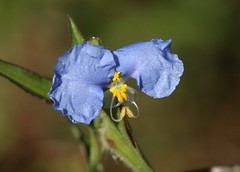
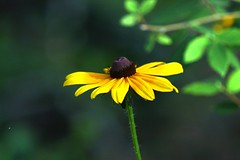
After watching these birds for a short while, I gave up my prime viewing spot to another birder who had joined me and headed deeper into the pine forest. The trail was lined in several places with wildflowers of all sorts. I can only imagine how beautiful the area must have looked a month ago when the spring flowers were in full bloom.

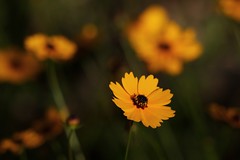
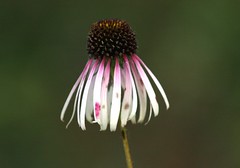
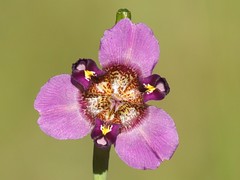
Wildflowers Wildflower Wild Iris Wildflower Black-eyed Susan

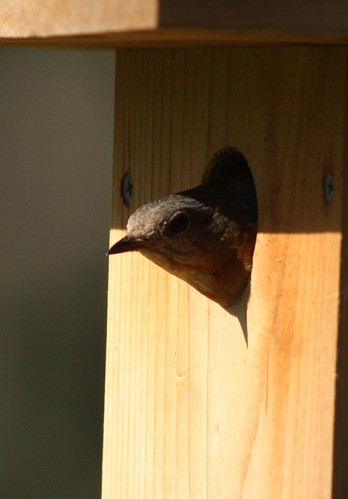
A volunteer organization has placed a number of bluebird nestboxes around the area, and I saw at least three that are in use.

Eastern Bluebird - 5/30/2009
Eastern Bluebird female (Sialia sialis)

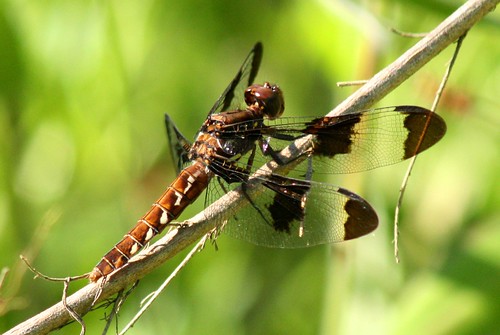
The woods were full of life, from the cawing of crows and the happy calls of cardinals, mockingbirds and pine warblers to the fluttering of a myriad of butterflies and dragonflies.

Dragonfly - 5/30/2009

And while I didn't see any of the other woodpecker species that normally summer in the area, like the Downy and the Red-bellied woodpeckers, the nesting Red-cockadeds and the abundance of Red-headed Woodpeckers that were all over the park were more than enough to satisfy my woodpecker cravings.

Red-headed Woodpecker - 5/30/2009

All in all, a fantastic morning of birding to kick off the summer season!

Monday, June 1, 2009

Breakfast with the Red-cockaded Woodpeckers

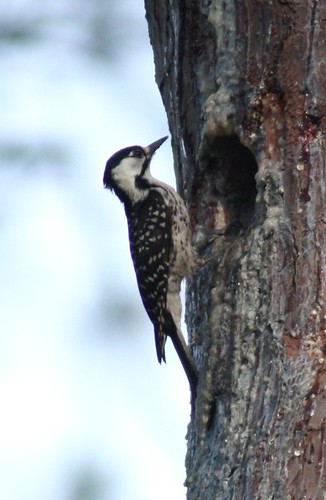
I got up early Saturday morning and headed north to W. G. Jones State Forest to look for woodpeckers. There had been reports of nesting activities up there on the TexBirds listserv, and I wanted to get out to see the Red-cockaded Woodpeckers while I had the chance. (By the way, thanks to Bill Godley of Brazos Bend State Park for the detailed directions on finding the nest trees!)

I stopped about halfway to the park to enjoy the beautiful sunrise, arriving at the ranger station about half an hour later. Following Bill's directions, I found the nesting tree and entrenched nearby to wait for this rare bird. And apparently I had timed it just right, because within fifteen minutes I began to see plenty of activity.

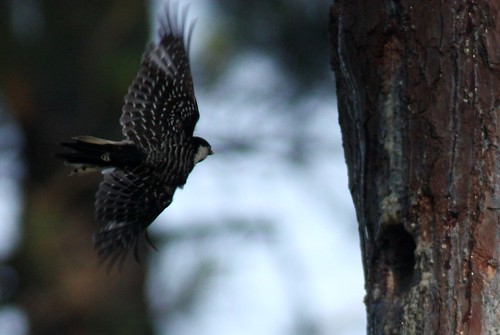
Red-cockaded Woodpecker - 5/30/2009
Red-cockaded Woodpecker (Picoides borealis)

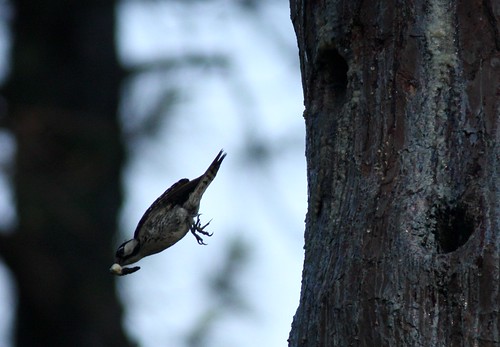
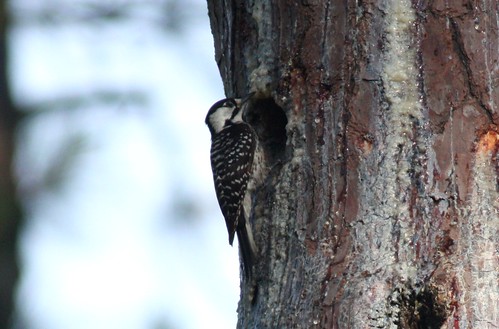
An adult woodpecker stuck its head out of the nest cavity briefly, then plunged from the tree and winged quickly away. I could immediately hear cries and squeaks coming from the tree, so there were obviously youngsters inside — and from the amount of noise and the sheer number of trips the parent made to and from the tree over the time I spent watching, I would guess there were several present in the nest.

Red-cockaded Woodpecker - 5/30/2009

Judging from the behavior at the cavity entrance and some (perceived) slight differences in facial markings, I'm pretty sure there were at least two adults participating in the breakfast foraging service, possibly more. One had a tendency to dive dramatically from the tree trunk — plunging sometimes six to ten feet before extending its wings to curve back upwards — while the other would often loop directly around the tree with hardly any dip in altitude. On at least two or three occasions, the departing adult would fly away with what seemed to be rejected bits of food (see above). They kept it up continuously, with a visit to the cavity at least once every five minutes or so.

Red-cockaded Woodpecker - 5/30/2009

Unlike most North American species of woodpeckers, Red-cockaded Woodpeckers build their cavities in live pines rather than dead trees. Their cavities can be found by the streaks of greenish white pine sap that run down from the holes they drill, which when hardened help to protect the nests from tree-climbing snakes. They often nest in small clusters and may have several adults that help the breeding pair in brooding and feeding the young.

Red-cockaded Woodpecker - 5/30/2009

Unfortunately, the babies were apparently not yet old enough to venture out of the nest, but it was still a fantastic morning of birding with plenty of activity. For a couple more shots of the Red-cockaded Woodpeckers, click here.

There were more sights to enjoy at Jones State Forest on this beautiful Saturday morning, including plenty of Red-headed Woodpeckers and an abundance of wildflowers scattered through the forest, but the Red-cockaded feeding frenzy was by far the most enjoyable. I'll add some more pictures from the morning's excursion in the next day or so.


For more great bird photos from around the world, check out Bird Photography Weekly #40.

Bird Photography Weekly

Monday, March 2, 2009

Bird Photography Weekly: Red-bellied Woodpecker

I was back at the park last week, looking for the local resident woodpeckers, and they did not disappoint. After waiting only a few minutes, this little lady put in an appearance.


Red-bellied Woodpecker (Melanerpes carolinus)

She quickly began putting on a show, flitting from one tree to another and energetically bouncing along the branches, enjoying the sunshine and cool breezes of the day.


When the woodpeck-pecker goes hop-hop-hopping along...

Suddenly I heard an explosion of activity and the sound of jays in the wooded area off to my left, quickly followed by the sharp call of a hawk. I glanced over to try to spot the goings on, but they were out of sight within the tree line.

When I turned back to follow the little red-bellied female, she was nowhere to be seen. She had been spooked — though whether by the commotion or by the hawk's call, I don't know — and had taken cover. It was several minutes before I finally spotted a small flash of red as she finally raised her head to warily look around.

Red-bellied Woodpecker - 2/23/2009

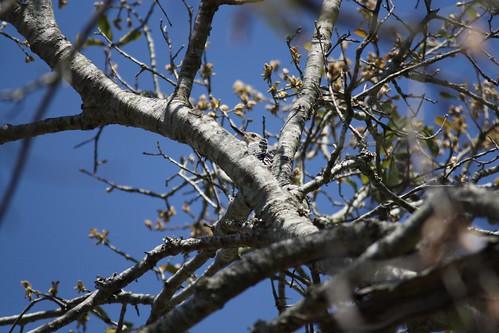
Hunkered down in the crook of the branches, she blended in with the bark so well that she was very well hidden until she began moving again.

Click on the last image above to see a nice close-up of the woodpecker in her hiding place. The deep ruby coloring of her eye is nothing short of gorgeous.


For more great bird photos from around the world, check out Bird Photography Weekly #27.

Bird Photography Weekly

Monday, February 16, 2009

Bird Photography Weekly: Red-headed Woodpecker

Here are a few more pictures of the juvenile (immature?) Red-headed Woodpecker I saw at Bear Creek Park last week.

(You can see larger versions of each photo on my Flickr photostream by simply clicking on the image, then on the "All Sizes" button above the image on Flickr.)

Red-headed Woodpecker - 2/11/2009
Juvenile Red-headed Woodpecker (Melanerpes erythrocephalus)

Red-headed Woodpecker - 2/11/2009

Thanks to Larry, who pointed out that this is properly labeled a "juvenile" bird. Which brings me to a question I've often wondered about: what is the difference between "juvenile" and "immature" when labeling a young bird? I have seen both terms used in different field guides and on bird sites, often times seemingly pointing to the same features to mark the birds as one or the other.

Red-headed Woodpecker - 2/11/2009
The woodpecker's lunch time coincided nicely with my own this day. About every two or three minutes he would launch himself either down to the ground or toward a nearby trunk and return quickly nearly every time with some sort of tasty morsel: grubs, flies and who knows what else.

Red-headed Woodpecker - 2/11/2009
This young Red-headed Woodpecker's still brown head was just beginning to show hints of the brilliant red hood it will eventually flaunt.

Red-headed Woodpecker - 2/11/2009

Red-headed Woodpecker - 2/11/2009

For more great bird photos from around the world, check out Bird Photography Weekly #25.

Bird Photography Weekly

Wednesday, February 11, 2009

Identification Milestone

I headed out to Bear Creek Park at lunch today for a little exercise and a quick bit of birding. I've been reading about the First Annual Rusty Blackbird Blitz, and thought I'd see if I could find the Rusty Blackbirds that have been reported at the park this week.

American Robin - 2/11/2009
American Robin (Turdus migratorius)

The first thing I found was a whole horde of robins. They've been all over the Houston area for a week or more — a sure sign that spring is right around the corner. Several others made an appearance before a pair of the much sought after Rusty Blackbirds finally showed. Rounding out the small count for the half hour were an Eastern Bluebird, a few vultures and crows, and a pair of woodpeckers.

The first woodpecker I spotted was a Red-bellied Woodpecker. But soon after, my attention was drawn to a darker bird of similar size but much more aggression. It took me a little while to recognize what I was seeing.

Red-headed Woodpecker - 2/11/2009
Immature Red-headed Woodpecker
(Melanerpes erythrocephalus)

An immature Red-headed Woodpecker had staked its claim to a nearby tree and was busy venturing from trunk to ground and back catching bugs, grubs and tasty treats. Its brown head was just beginning to show hints of the bright red hood it will eventually flaunt.


Further evidence of its immaturity was demonstrated as it showed juvenile delinquent tendencies, repeatedly launching itself at its red-bellied cousin several trees away and finally driving the other woodpecker from the area.

But the highlight of my lunchtime excursion came from a pair of warblers that ventured down to the damp grass nearby, although it was not so much the sighting as the recognition of these two that got me so excited.

click image to enlarge
Yellow-rumped Warbler (Dendroica coronate)

I mean, sure, one of them was a "butterbutt." But I recognized it! First time I've ever been able to identify a warbler on my own, and in the field at that. Definitely a milestone worth celebrating!

The second one took a little more work and cross-checking between my Peterson and Sibley guides, but I'm pretty sure I nailed this one, too. If not, I trust someone will let me know and give me another lesson on warblers...

click image to enlarge
Pine Warbler (Dendroica pinus)

I trust you will excuse the quality of these last two images, but I had to have some proof to share of my milestone.

Friday, January 30, 2009

Unclear on the Concept

Red-bellied Woodpecker. Wood pecker. Seems simple enough, doesn't it?

But this fellow seemed a little unclear on the concept.

click image to enlarge
I came across this feisty little woodpecker at a local park the other day. As I walked from my car, I heard a strange sequence of sounds coming from the nearby tennis court. Moving in that direction, I spotted him perched on the side of a metal pole, alternately rapping on the hard surface and stopping to listen. After a moment, he hopped up to the top of the chain link fence and peered down as if to inspect the problem from a different angle. Then he chittered loudly and flew along the fence to the next pole.

click image to enlarge
Where are all the bugs? There ought to be bugs!

After repeating this on at least four poles, each followed with what seemed to be increasingly frustrated chattering, the little woodpecker finally reached the end of the fence. With a final loud chirp, as if to say, "I give up!" he flew off toward a stand of nearby trees.

I might have just imagined it, but I thought I heard a small, satisfied squeak as I walked on. Perhaps he finally found what he was looking for.

Wood.

Friday, January 16, 2009

The Further Adventures of "Beginning BirderMan"!

I made another brief trip out to Bear Creek Park earlier this week. The bad thing about Bear Creek is that it takes the majority of my short lunch break just driving there and back to the office. The good thing is that it's a beautiful place with a nice variety of bird life and plenty of wooded area, and it is virtually empty on weekdays (at least during this time of year).

This week, the work crews were busy around the park, noisily clearing away piled up brush and using tractors to spread heaping mounds of ground up Christmas trees. I headed down the nature / equestrian path for quite a ways before encountering any bird life bold enough to face the crashes and bangs coming from the treeline. (I doubt my slipping, sliding and crunching along the muddy and leaf strewn path had anything to do with it.)

Finally I started seeing life in the bare branches, starting with a pair of chickadees.

click image to enlarge
Carolina Chickadee (Poecile carolinensis)

After a bit, I locked onto a Downy Woodpecker further down the trail, and tried my best to approach within camera range without disturbing her. Twice I almost got a shot before she hopped around a trunk or flittered to a more obscured branch, but I kept hearing her rat-a-tat-a-tat and kept inching closer. Then the drumming sounds changed, coming from another direction entirely. I thought at first that the downy had flown the coop, so to speak. But this sound was different; deeper, louder, more "echo-y," if you know what I mean.

Then I heard it, and even with my limited experience I caught my breath. I'd heard that sound before, plenty of times up in the piney woods of East Texas, but I'd never seen the originator of that distinctive call. That wonderful, maniacal laugh (audio files borrowed from PileatedWoodpeckerCentral). And I immediately and totally forgot the little downy.

Slowly moving toward the source of the call, I saw a great flutter of black. At first I thought I was seeing a vulture back in the trees. Surely woodpeckers don't grow that big! Then I saw a flash of red and stopped in my tracks.

click image to enlarge
I waited a bit and watched as he moved slowly closer, still staying deep in the tangle of trunks and leafless branches. Finally I got a good view of him and snapped as many quick shots as I could get before he moved behind thicker underbrush.

click image to enlarge
Pileated Woodpecker (Dryocopus pileatus)

Glancing down at my watch, I realized I was almost twenty minutes late starting back towards the office. I scrambled back down the trail and into the car.

Luckily everyone was hard at work when I snuck back to my desk and no one seemed to notice my extended lunch break. It would have been worth it, though, even if I'd gotten caught. Chalk up another lifer for this new year!


For some great bird photos from around the world, check out Bird Photography Weekly #21.

Bird Photography Weekly